In modern civil engineering, foundation reinforcement and slope protection have long been key challenges for engineers and contractors. Traditional methods often face issues such as high costs, long construction periods, and poor environmental adaptability. As a significant innovation in the field of geosynthetics, Geocell — with its unique three-dimensional cellular structure and superior mechanical properties — is providing efficient, cost-effective, and environmentally friendly solutions for highway and railway construction, hydraulic engineering, mining rehabilitation, and more.
What is Geocell?
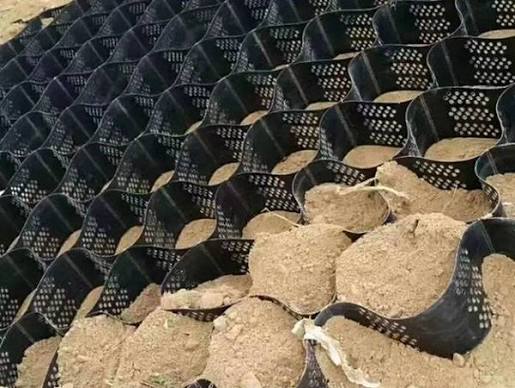
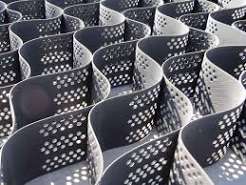
Geocell is a three-dimensional cellular confinement system made from high-strength HDPE (High-Density Polyethylene) sheets, joined by high-power ultrasonic welding. Its core design concept is inspired by the honeycomb structure in nature — forming a continuous 3D confinement system through the combination of planar and vertical confinement.
Geocell features expandable and collapsible characteristics: it can be folded into rolls during transport, saving significant shipping space; during installation, it is expanded into a cellular network, and after being filled with loose materials such as soil, gravel, or concrete, it forms a structure with strong lateral confinement and high rigidity. This “fold first, expand later” feature gives it a distinct advantage in complex terrains and remote construction sites.
Key Advantages
1. Powerful Foundation Reinforcement
Geocell enhances fill confinement through its 3D confinement system, using lateral confinement and friction to restrain material displacement. This significantly improves subgrade bearing capacity and load distribution. In saturated loess foundations, the bearing capacity can be increased by 2 to 3 times after installing geocell.
2. Excellent Slope Protection Performance
When geocell is anchored on slope surfaces and filled with topsoil, gravel, or other materials, it forms a structural layer with lateral confinement and certain rigidity, providing the necessary conditions for vegetation growth and achieving ecological slope greening and protection, effectively preventing soil erosion. In loess slope tests, the average cumulative erosion rate was reduced by up to 48% after geocell installation.
3. Lightweight, Durable, and Long Service Life
Geocell is lightweight, wear-resistant, chemically stable, resistant to photo-oxidative aging and acid/alkali corrosion, making it suitable for various soil conditions including sand and desert areas. New modified geocell materials show significantly enhanced tensile and creep resistance, with a service life that can be predicted to exceed 50 years.
4. Fast Installation and Cost-Effective
Geocell allows for rapid construction with minimal equipment requirements, helping to shorten project timelines and reduce overall costs.
Applications
Geocell is widely used in:
- Road and railway subgrade reinforcement
- Slope protection and erosion control
- Retaining wall construction
- Channel and reservoir lining
- Load support for parking lots, ports, and airports
- Mining site rehabilitation and landfill lining
Post time: Jul-04-2026


